
Your credit score is based on five key factors that lenders use to evaluate your financial reliability. Understanding how each factor works allows you to improve your score faster and avoid the mistakes that keep it low.
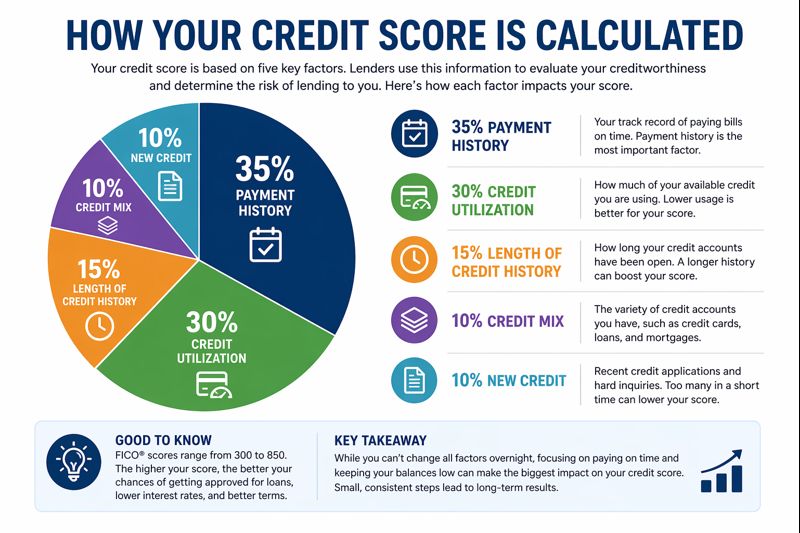
What Makes Up Your Credit Score
Your credit score is calculated using the following breakdown:
- 35% – Payment History
- 30% – Credit Utilization
- 15% – Length of Credit History
- 10% – Credit Mix
- 10% – New Credit
Each of these factors plays a different role in determining your overall score.
How to Improve Your Credit Score Step-by-Step
1-Payment History (35%) – The Most Important Factor
Your payment history has the biggest impact on your credit score. Even one missed payment can significantly lower your score.
How to improve it:
- Pay every bill on time
- Set up automatic payments or reminders
- Bring any past-due accounts current immediately
- Avoid collections whenever possible
2-Credit Utilization (30%) – Fastest Way to Boost Your Score
Credit utilization refers to how much of your available credit you’re using.
Example:
If your credit limit is $1,000 and your balance is $500, your utilization is 50%—which is too high.
How to improve it:
- Keep your usage below 30% (under 10% is ideal)
- Pay down balances before your statement closing date
- Spread balances across multiple cards
- Request a credit limit increase (without increasing spending)
3-Length of Credit History (15%)
The longer your credit accounts have been open, the better it is for your score.
How to improve it:
- Keep older accounts open
- Avoid closing your oldest credit cards
- Limit opening too many new accounts
4-Credit Mix (10%)
Your credit mix refers to the different types of accounts you have.
Examples include:
- Credit cards
- Auto loans
- Personal loans
- Mortgages
How to improve it:
- Maintain a mix of credit types if possible
- Don’t open accounts unnecessarily just to improve mix
5-New Credit (10%)
Applying for new credit creates hard inquiries, which can temporarily lower your score.
How to improve it:
- Apply for credit only when necessary
- Space applications at least 3–6 months apart
- Avoid multiple applications in a short period
Common Mistakes That Lower Your Credit Score
Missing payments
Maxing out credit cards
Closing old accounts
Applying for too much credit too quickly
How Long Does It Take to Improve Your Credit Score
Improving your credit score takes time, but results can come faster than most people expect:
- Small improvements: 30–60 days
- Moderate improvements: 3–6 months
- Major improvements: 6–12+ months
Consistency is the key to long-term results.
Get Help Improving Your Credit Faster
If you want to improve your credit score quickly and avoid costly mistakes, having the right strategy makes a major difference.